From Wikipedia, the free encyclopedia
"Photographic" redirects here. For the image obtained, see Photograph. For other uses, see Photography (disambiguation).

Lens and mounting of a large-format camera
Typically, a lens is used to focus the light reflected or emitted from objects into a real image on the light-sensitive surface inside a camera during a timed exposure. With an electronic image sensor, this produces an electrical charge at each pixel, which is electronically processed and stored in a digital image file for subsequent display or processing. The result with photographic emulsion is an invisible latent image, which is later chemically "developed" into a visible image, either negative or positive depending on the purpose of the photographic material and the method of processing. A negative image on film is traditionally used to photographically create a positive image on a paper base, known as a print, either by using an enlarger or by contact printing.
Photography is employed in many fields of science, manufacturing (e.g., photolithography) and business, as well as its more direct uses for art, film and video production, recreational purposes, hobby, and mass communication.
Contents
Etymology
The word "photography" was created from the Greek roots φωτός (phōtos), genitive of φῶς (phōs), "light"[2] and γραφή (graphé) "representation by means of lines" or "drawing",[3] together meaning "drawing with light".[4]Several people may have coined the same new term from these roots independently. Hercules Florence, a French painter and inventor living in Campinas, Brazil, used the French form of the word, photographie, in private notes which a Brazilian photography historian believes were written in 1834.[5] Johann von Maedler, a Berlin astronomer, is credited in a 1932 German history of photography as having used it in an article published on 25 February 1839 in the German newspaper Vossische Zeitung.[6] Both of these claims are now widely reported but apparently neither has ever been independently confirmed as beyond reasonable doubt. Credit has traditionally been given to Sir John Herschel both for coining the word and for introducing it to the public. His uses of it in private correspondence prior to 25 February 1839 and at his Royal Society lecture on the subject in London on 14 March 1839 have long been amply documented and accepted as settled facts.
History
Main article: History of photography
See also: History of the camera
Precursor technologies

A camera obscura used for drawing images
Daniele Barbaro described a diaphragm in 1566.[16] Wilhelm Homberg described how light darkened some chemicals (photochemical effect) in 1694.[17] The fiction book Giphantie, published in 1760, by French author Tiphaigne de la Roche, described what can be interpreted as photography.[16]
The discovery of the camera obscura that provides an image of a scene dates back to ancient China. Leonardo da Vinci mentions natural camerae obscurae that are formed by dark caves on the edge of a sunlit valley. A hole in the cave wall will act as a pinhole camera and project a laterally reversed, upside down image on a piece of paper. So the birth of photography was primarily concerned with inventing means to fix and retain the image produced by the camera obscura.
Renaissance painters used the camera obscura which, in fact, gives the optical rendering in color that dominates Western Art. The camera obscura literally means "dark chamber" in Latin. It is a box with a hole in it which allows light to go through and create an image onto the piece of paper.
Invention of photography

Earliest known surviving heliographic engraving, 1825, printed from a metal plate made by Nicéphore Niépce.[18]
The plate was exposed under an ordinary engraving and copied it by
photographic means. This was a step towards the first permanent
photograph taken with a camera.
The first permanent photoetching was an image produced in 1822 by the French inventor Nicéphore Niépce, but it was destroyed in a later attempt to make prints from it.[18] Niépce was successful again in 1825. In 1826 or 1827, he made the View from the Window at Le Gras, the earliest surviving photograph from nature (i.e., of the image of a real-world scene, as formed in a camera obscura by a lens).[20]

World's earliest surviving camera photograph, 1826 or 1827: View from the Window at Le Gras
Niépce died in 1833 and Daguerre then redirected the experiments toward the light-sensitive silver halides, which Niépce had abandoned many years earlier because of his inability to make the images he captured with them light-fast and permanent. Daguerre's efforts culminated in what would later be named the daguerreotype process, the essential elements of which were in place in 1837. The required exposure time was measured in minutes instead of hours. Daguerre took the earliest confirmed photograph of a person in 1838 while capturing a view of a Paris street: unlike the other pedestrian and horse-drawn traffic on the busy boulevard, which appears deserted, one man having his boots polished stood sufficiently still throughout the approximately ten-minute-long exposure to be visible. The existence of Daguerre's process was publicly announced, without details, on 7 January 1839. The news created an international sensation. France soon agreed to pay Daguerre a pension in exchange for the right to present his invention to the world as the gift of France, which occurred when complete working instructions were unveiled on 19 August 1839.

A latticed window in Lacock Abbey, England, photographed by William Fox Talbot in 1835. Shown here in positive form, this may be the oldest extant photographic negative made in a camera.
John Herschel made many contributions to the new field. He invented the cyanotype process, later familiar as the "blueprint". He was the first to use the terms "photography", "negative" and "positive". He had discovered in 1819 that sodium thiosulphate was a solvent of silver halides, and in 1839 he informed Talbot (and, indirectly, Daguerre) that it could be used to "fix" silver-halide-based photographs and make them completely light-fast. He made the first glass negative in late 1839.
In the March 1851 issue of The Chemist, Frederick Scott Archer published his wet plate collodion process. It became the most widely used photographic medium until the gelatin dry plate, introduced in the 1870s, eventually replaced it. There are three subsets to the collodion process; the Ambrotype (a positive image on glass), the Ferrotype or Tintype (a positive image on metal) and the glass negative, which was used to make positive prints on albumen or salted paper.
Many advances in photographic glass plates and printing were made during the rest of the 19th century. In 1891, Gabriel Lippmann introduced a process for making natural-color photographs based on the optical phenomenon of the interference of light waves. His scientifically elegant and important but ultimately impractical invention earned him the Nobel Prize for Physics in 1908.
Glass plates were the medium for most original camera photography from the late 1850s until the general introduction of flexible plastic films during the 1890s. Although the convenience of film greatly popularized amateur photography, early films were somewhat more expensive and of markedly lower optical quality than their glass plate equivalents, and until the late 1910s they were not available in the large formats preferred by most professional photographers, so the new medium did not immediately or completely replace the old. Because of the superior dimensional stability of glass, the use of plates for some scientific applications, such as astrophotography, continued into the 1990s, and in the niche field of laser holography it has persisted into the 2010s.
Film photography
Main article: Photographic film

Undeveloped Arista black-and-white film, ISO 125/22°
The first flexible photographic roll film was marketed by George Eastman in 1885, but this original "film" was actually a coating on a paper base. As part of the processing, the image-bearing layer was stripped from the paper and transferred to a hardened gelatin support. The first transparent plastic roll film followed in 1889. It was made from highly flammable nitrocellulose ("celluloid"), now usually called "nitrate film".
Although cellulose acetate or "safety film" had been introduced by Kodak in 1908,[24] at first it found only a few special applications as an alternative to the hazardous nitrate film, which had the advantages of being considerably tougher, slightly more transparent, and cheaper. The changeover was not completed for X-ray films until 1933, and although safety film was always used for 16 mm and 8 mm home movies, nitrate film remained standard for theatrical 35 mm motion pictures until it was finally discontinued in 1951.
Films remained the dominant form of photography until the early 21st century, when advances in digital photography drew consumers to digital formats.[25] Although modern photography is dominated by digital users, film continues to be used by enthusiasts and professional photographers. The distinctively "look" of film based photographs compared to digital images is likely due to a combination of factors, including: (1) differences in spectral and tonal sensitivity (S-shaped density-to-exposure (H&D curve) with film vs. linear response curve for digital CCD sensors [26] (2) resolution and (3) continuity of tone.[27]
Black-and-white
Main article: Monochrome photography
Originally, all photography was monochrome, or black-and-white.
Even after color film was readily available, black-and-white
photography continued to dominate for decades, due to its lower cost and
its "classic" photographic look. The tones and contrast between light
and dark areas define black-and-white photography.[28]
It is important to note that monochromatic pictures are not necessarily
composed of pure blacks, whites, and intermediate shades of gray, but
can involve shades of one particular hue depending on the process. The cyanotype process, for example, produces an image composed of blue tones. The albumen print process, first used more than 160 years ago, produces brownish tones.
Many photographers continue to produce some monochrome images, sometimes because of the established archival permanence of well-processed silver-halide-based materials. Some full-color digital images are processed using a variety of techniques to create black-and-white results, and some manufacturers produce digital cameras that exclusively shoot monochrome. Monochrome printing or electronic display can be used to salvage certain photographs taken in color which are unsatisfactory in their original form; sometimes when presented as black-and-white or single-color-toned images they are found to be more effective. Although color photography has long predominated, monochrome images are still produced, mostly for artistic reasons. Almost all digital cameras have an option to shoot in monochrome, and almost all image editing software can combine or selectively discard RGB color channels to produce a monochrome image from one shot in color.
Color
Main article: Color photography

Color photography was possible long before Kodachrome, as this 1903 portrait by Sarah Angelina Acland
demonstrates, but in its earliest years the need for special equipment,
long exposures and complicated printing processes made it extremely
rare.
The first permanent color photograph was taken in 1861 using the three-color-separation principle first published by physicist James Clerk Maxwell in 1855. Maxwell's idea was to take three separate black-and-white photographs through red, green and blue filters. This provides the photographer with the three basic channels required to recreate a color image. Transparent prints of the images could be projected through similar color filters and superimposed on the projection screen, an additive method of color reproduction. A color print on paper could be produced by superimposing carbon prints of the three images made in their complementary colors, a subtractive method of color reproduction pioneered by Louis Ducos du Hauron in the late 1860s.
Russian photographer Sergei Mikhailovich Prokudin-Gorskii made extensive use of this color separation technique, employing a special camera which successively exposed the three color-filtered images on different parts of an oblong plate. Because his exposures were not simultaneous, unsteady subjects exhibited color "fringes" or, if rapidly moving through the scene, appeared as brightly colored ghosts in the resulting projected or printed images.
Implementation of color photography was hindered by the limited sensitivity of early photographic materials, which were mostly sensitive to blue, only slightly sensitive to green, and virtually insensitive to red. The discovery of dye sensitization by photochemist Hermann Vogel in 1873 suddenly made it possible to add sensitivity to green, yellow and even red. Improved color sensitizers and ongoing improvements in the overall sensitivity of emulsions steadily reduced the once-prohibitive long exposure times required for color, bringing it ever closer to commercial viability.
Autochrome, the first commercially successful color process, was introduced by the Lumière brothers in 1907. Autochrome plates incorporated a mosaic color filter layer made of dyed grains of potato starch, which allowed the three color components to be recorded as adjacent microscopic image fragments. After an Autochrome plate was reversal processed to produce a positive transparency, the starch grains served to illuminate each fragment with the correct color and the tiny colored points blended together in the eye, synthesizing the color of the subject by the additive method. Autochrome plates were one of several varieties of additive color screen plates and films marketed between the 1890s and the 1950s.
Kodachrome, the first modern "integral tripack" (or "monopack") color film, was introduced by Kodak in 1935. It captured the three color components in a multi-layer emulsion. One layer was sensitized to record the red-dominated part of the spectrum, another layer recorded only the green part and a third recorded only the blue. Without special film processing, the result would simply be three superimposed black-and-white images, but complementary cyan, magenta, and yellow dye images were created in those layers by adding color couplers during a complex processing procedure.
Agfa's similarly structured Agfacolor Neu was introduced in 1936. Unlike Kodachrome, the color couplers in Agfacolor Neu were incorporated into the emulsion layers during manufacture, which greatly simplified the processing. Currently available color films still employ a multi-layer emulsion and the same principles, most closely resembling Agfa's product.
Instant color film, used in a special camera which yielded a unique finished color print only a minute or two after the exposure, was introduced by Polaroid in 1963.
Color photography may form images as positive transparencies, which can be used in a slide projector, or as color negatives intended for use in creating positive color enlargements on specially coated paper. The latter is now the most common form of film (non-digital) color photography owing to the introduction of automated photo printing equipment. After a transition period centered around 1995–2005, color film was relegated to a niche market by inexpensive multi-megapixel digital cameras. Film continues to be the preference of some photographers because of its distinctive "look".
Digital photography
Main article: Digital photography
See also: Digital camera
In 1981, Sony unveiled the first consumer camera to use a charge-coupled device for imaging, eliminating the need for film: the Sony Mavica.
While the Mavica saved images to disk, the images were displayed on
television, and the camera was not fully digital. In 1991, Kodak
unveiled the DCS 100, the first commercially available digital single lens reflex camera. Although its high cost precluded uses other than photojournalism and professional photography, commercial digital photography was born.Digital imaging uses an electronic image sensor to record the image as a set of electronic data rather than as chemical changes on film.[29] An important difference between digital and chemical photography is that chemical photography resists photo manipulation because it involves film and photographic paper, while digital imaging is a highly manipulative medium. This difference allows for a degree of image post-processing that is comparatively difficult in film-based photography and permits different communicative potentials and applications.
Digital photography dominates the 21st century. More than 99% of photographs taken around the world are through digital cameras, increasingly through smartphones.
Synthesis photography
Synthesis photography is part of computer-generated imagery (CGI) where the shooting process is modeled on real photography. The CGI, creating digital copies of real universe, requires a visual representation process of these universes. Synthesis photography is the application of analog and digital photography in digital space. With the characteristics of the real photography but not being constrained by the physical limits of real world, synthesis photography allows to get away from real photography.[30]Evolution of the camera
-
 Late 19th century studio camera, standing on tripod, used glass photographic plates
-
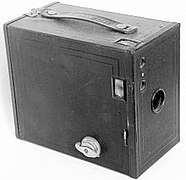 Point-and-shoot box camera, the first type of mass-produced film camera, c. 1910s
-
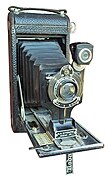 Compact Kodak folding camera from 1922
-
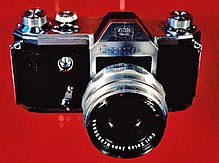
-
 Polaroid Colorpack 80 instant camera, c 1975
-
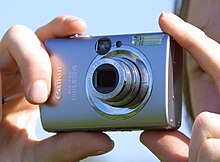
-
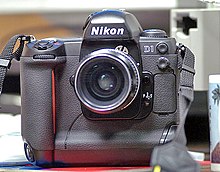 Nikon D1, the first digital SLR used in journalism and sports photography, c. 2000
-
 Smartphone with built-in camera spreads private images globally, c. 2010


Technical aspects
Main article: Camera
The camera is the image-forming device, and a photographic plate, photographic film or a silicon electronic image sensor
is the capture medium. The respective recording medium can be the plate
or film itself, or a digital magnetic or electronic memory.[31]Photographers control the camera and lens to "expose" the light-recording material to the required amount of light to form a "latent image" (on plate or film) or RAW file (in digital cameras) which, after appropriate processing, is converted to a usable image. Digital cameras use an electronic image sensor based on light-sensitive electronics such as charge-coupled device (CCD) or complementary metal-oxide-semiconductor (CMOS) technology. The resulting digital image is stored electronically, but can be reproduced on a paper.
The camera (or 'camera obscura') is a dark room or chamber from which, as far as possible, all light is excluded except the light that forms the image. The subject being photographed, however, must be illuminated. Cameras can range from small to very large, a whole room that is kept dark while the object to be photographed is in another room where it is properly illuminated. This was common for reproduction photography of flat copy when large film negatives were used (see Process camera).
As soon as photographic materials became "fast" (sensitive) enough for taking candid or surreptitious pictures, small "detective" cameras were made, some actually disguised as a book or handbag or pocket watch (the Ticka camera) or even worn hidden behind an Ascot necktie with a tie pin that was really the lens.
The movie camera is a type of photographic camera which takes a rapid sequence of photographs on recording medium. In contrast to a still camera, which captures a single snapshot at a time, the movie camera takes a series of images, each called a "frame". This is accomplished through an intermittent mechanism. The frames are later played back in a movie projector at a specific speed, called the "frame rate" (number of frames per second). While viewing, a person's eyes and brain merge the separate pictures together to create the illusion of motion.[32]
Camera controls
In all but certain specialized cameras, the process of obtaining a usable exposure must involve the use, manually or automatically, of a few controls to ensure the photograph is clear, sharp and well illuminated. The controls usually include but are not limited to the following:| Control | Description |
|---|---|
| Focus | The position of a viewed object or the adjustment of an optical device necessary to produce a clear image: in focus; out of focus.[33] |
| Aperture | Adjustment of the lens opening, measured as f-number, which controls the amount of light passing through the lens. Aperture also has an effect on depth of field and diffraction – the higher the f-number, the smaller the opening, the less light, the greater the depth of field, and the more the diffraction blur. The focal length divided by the f-number gives the effective aperture diameter. |
| Shutter speed | Adjustment of the speed (often expressed either as fractions of seconds or as an angle, with mechanical shutters) of the shutter to control the amount of time during which the imaging medium is exposed to light for each exposure. Shutter speed may be used to control the amount of light striking the image plane; 'faster' shutter speeds (that is, those of shorter duration) decrease both the amount of light and the amount of image blurring from motion of the subject and/or camera. The slower shutter speeds allow for long exposure shots that are done used to photograph images in very low light, including the images of the night sky. |
| White balance | On digital cameras, electronic compensation for the color temperature associated with a given set of lighting conditions, ensuring that white light is registered as such on the imaging chip and therefore that the colors in the frame will appear natural. On mechanical, film-based cameras, this function is served by the operator's choice of film stock or with color correction filters. In addition to using white balance to register natural coloration of the image, photographers may employ white balance to aesthetic end, for example white balancing to a blue object in order to obtain a warm color temperature. |
| Metering | Measurement of exposure so that highlights and shadows are exposed according to the photographer's wishes. Many modern cameras meter and set exposure automatically. Before automatic exposure, correct exposure was accomplished with the use of a separate light metering device or by the photographer's knowledge and experience of gauging correct settings. To translate the amount of light into a usable aperture and shutter speed, the meter needs to adjust for the sensitivity of the film or sensor to light. This is done by setting the "film speed" or ISO sensitivity into the meter. |
| Film speed | Traditionally used to "tell the camera" the film speed of the selected film on film cameras, film speed numbers are employed on modern digital cameras as an indication of the system's gain from light to numerical output and to control the automatic exposure system. Film speed is usually measured via the ISO system. The higher the film speed number the greater the film sensitivity to light, whereas with a lower number, the film is less sensitive to light. A correct combination of film speed, aperture, and shutter speed leads to an image that is neither too dark nor too light, hence it is 'correctly exposed', indicated by a centered meter. |
| Autofocus point | On some cameras, the selection of a point in the imaging frame upon which the auto-focus system will attempt to focus. Many Single-lens reflex cameras (SLR) feature multiple auto-focus points in the viewfinder. |
- Focal length and type of lens (normal, long focus, wide angle, telephoto, macro, fisheye, or zoom)
- Filters placed between the subject and the light recording material, either in front of or behind the lens
- Inherent sensitivity of the medium to light intensity and color/wavelengths.
- The nature of the light recording material, for example its resolution as measured in pixels or grains of silver halide.
Exposure and rendering


The duration of an exposure is referred to as shutter speed, often even in cameras that do not have a physical shutter, and is typically measured in fractions of a second. It is quite possible to have exposures from one up to several seconds, usually for still-life subjects, and for night scenes exposure times can be several hours. However, for a subject that is in motion use a fast shutter speed. This will prevent the photograph from coming out blurry.[35]
The effective aperture is expressed by an f-number or f-stop (derived from focal ratio), which is proportional to the ratio of the focal length to the diameter of the aperture. Longer lenses will pass less light even though the diameter of the aperture is the same due to the greater distance the light has to travel; shorter lenses (a shorter focal length) will be brighter with the same size of aperture.
The smaller the f/number, the larger the effective aperture. The present system of f/numbers to give the effective aperture of a lens was standardized by an international convention. There were earlier, different series of numbers in older cameras.
If the f-number is decreased by a factor of √2, the aperture diameter is increased by the same factor, and its area is increased by a factor of 2. The f-stops that might be found on a typical lens include 2.8, 4, 5.6, 8, 11, 16, 22, 32, where going up "one stop" (using lower f-stop numbers) doubles the amount of light reaching the film, and stopping down one stop halves the amount of light.
Image capture can be achieved through various combinations of shutter speed, aperture, and film or sensor speed. Different (but related) settings of aperture and shutter speed enable photographs to be taken under various conditions of film or sensor speed, lighting and motion of subjects and/or camera, and desired depth of field. A slower speed film will exhibit less "grain", and a slower speed setting on an electronic sensor will exhibit less "noise", while higher film and sensor speeds allow for a faster shutter speed, which reduces motion blur or allows the use of a smaller aperture to increase the depth of field.
For example, a wider aperture is used for lower light and a lower aperture for more light. If a subject is in motion, then a high shutter speed may be needed. A tripod can also be helpful in that it enables a slower shutter speed to be used.
For example, f/8 at 8 ms (1/125 of a second) and f/5.6 at 4 ms (1/250 of a second) yield the same amount of light. The chosen combination has an impact on the final result. The aperture and focal length of the lens determine the depth of field, which refers to the range of distances from the lens that will be in focus. A longer lens or a wider aperture will result in "shallow" depth of field (i.e., only a small plane of the image will be in sharp focus). This is often useful for isolating subjects from backgrounds as in individual portraits or macro photography.
Conversely, a shorter lens, or a smaller aperture, will result in more of the image being in focus. This is generally more desirable when photographing landscapes or groups of people. With very small apertures, such as pinholes, a wide range of distance can be brought into focus, but sharpness is severely degraded by diffraction with such small apertures. Generally, the highest degree of "sharpness" is achieved at an aperture near the middle of a lens's range (for example, f/8 for a lens with available apertures of f/2.8 to f/16). However, as lens technology improves, lenses are becoming capable of making increasingly sharp images at wider apertures.
Image capture is only part of the image forming process. Regardless of material, some process must be employed to render the latent image captured by the camera into a viewable image. With slide film, the developed film is just mounted for projection. Print film requires the developed film negative to be printed onto photographic paper or transparency. Prior to the advent of laser jet and inkjet printers, celluloid photographic negative images had to be mounted in an enlarger which projected the image onto a sheet of light-sensitive paper for a certain length of time (usually measured in seconds or fractions of a second). This sheet then was soaked in a chemical bath of developer (to bring out the image) followed immediately by a stop bath (to neutralize the progression of development and prevent the image from changing further once exposed to normal light). After this, the paper was hung until dry enough to safely handle. This post-production process allowed the photographer to further manipulate the final image beyond what had already been captured on the negative, adjusting the length of time the image was projected by the enlarger and the duration of both chemical baths to change the image's intensity, darkness, clarity, etc. This process is still employed by both amateur and professional photographers, but the advent of digital imagery means that the vast majority of modern photographic work is captured digitally and rendered via printing processes that are no longer dependent on chemical reactions to light. Such digital images may be uploaded to an image server (e.g., a photo-sharing web site), viewed on a television, or transferred to a computer or digital photo frame. Every type can then be produced as a hard copy on regular paper or photographic paper via a printer.
Prior to the rendering of a viewable image, modifications can be made using several controls. Many of these controls are similar to controls during image capture, while some are exclusive to the rendering process. Most printing controls have equivalent digital concepts, but some create different effects. For example, dodging and burning controls are different between digital and film processes. Other printing modifications include:

- Chemicals and process used during film development.
- Duration of print exposure – equivalent to shutter speed
- Printing aperture – equivalent to aperture, but has no effect on depth of field
- Contrast – changing the visual properties of objects in an image to make them distinguishable from other objects and the background
- Dodging – reduces exposure of certain print areas, resulting in lighter areas
- Burning in – increases exposure of certain areas, resulting in darker areas
- Paper texture – glossy, matte, etc.
- Paper type – resin-coated (RC) or fiber-based (FB)
- Paper size
- Exposure Shape — resulting prints in shapes such as circular, oval, loupe, etc.
- Toners – used to add warm or cold tones to black-and-white prints
Comments
Post a Comment